
Plain Text SPAM Emails Are Still Subject to the Law
Not long ago, you could spot a spam email from a mile away.
It was full of flashy graphics, brightly colored buttons, suspicious hyperlinks, and enough marketing language to make it obvious that someone was trying to sell you something.
Email providers became exceptionally good at identifying these messages before they ever reached your inbox. They analyzed the sender's reputation, examined embedded links, evaluated HTML formatting, inspected domain authentication, and considered countless other signals to determine whether a message belonged in your inbox or your spam folder.
Over time, the spam filters got smarter.
So did the spammers.
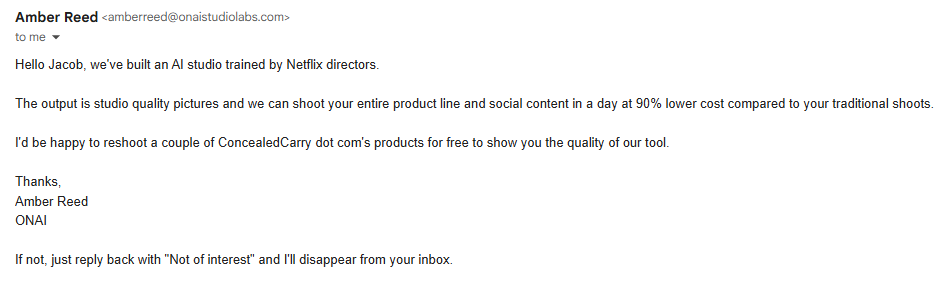
This is better than some because they actually do provide an opt-out method, but its still blatantly illegal because it doesn't include all required disclosures.
The latest evolution in unsolicited marketing isn't a sophisticated HTML email with polished graphics. In fact, it's exactly the opposite. Today's mass marketing emails are increasingly plain text. They contain no images, no buttons, few if any links, and often read as though they were personally written by someone who simply wanted to introduce themselves.
They're designed to look like a genuine one-to-one email.
Most of the time, they aren't.
Table of Contents
Why Plain Text Works
Email providers have become remarkably effective at recognizing traditional marketing emails.
Embedded links can be analyzed. Their destinations can be evaluated. Domains develop reputations over time. Sending IP addresses accumulate trust, or lose it. HTML formatting itself provides clues about whether a message is likely to be a commercial advertisement.
Plain text removes many of those clues.
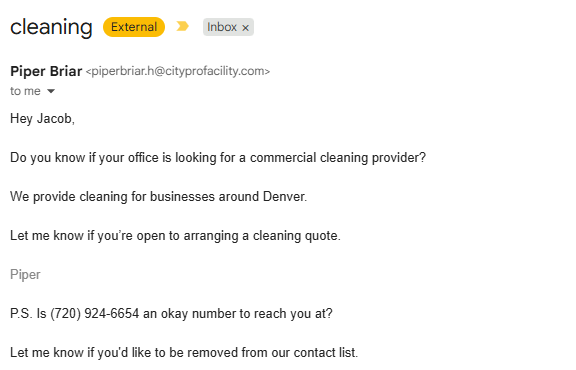
Illegal
Without buttons, graphics, tracking links, or elaborate formatting, the message resembles the kind of email you might receive from a colleague, customer, or acquaintance.
The call to action is often nothing more than:
Would you be interested?
Reply and let me know.
Can we schedule fifteen minutes?
From the perspective of a spam filter, that's a much more difficult message to classify than an email full of promotional banners and “Buy Now” buttons.
The objective isn't necessarily to fool you.
It's to fool the email provider just long enough to reach you.
Technology Has Changed the Game
Modern marketing software has made the process even easier.
Years ago, building a bad reputation with email providers could effectively ruin a spam operation. Domains and IP addresses accumulated negative reputations over time.
Today, software makes it remarkably easy to rotate domains, rotate sending infrastructure, and continually introduce fresh sending sources before any one identity develops a terrible reputation.
The strategy reminds me of telemarketers who constantly spoof local phone numbers.
The number on your caller ID appears local because you're more likely to answer.
It's deceptive.
It's also effective.
The same principle now applies to email.
An Important Clarification
Before I go any further, it's worth making an important distinction.
Not every unsolicited email is a marketing email, and not every one-to-one email is subject to the requirements discussed in this article. A genuine email personally written by one individual to another—for networking, customer service, recruiting, journalism, or other legitimate business purposes—may not be considered a commercial marketing email under the CAN-SPAM Act.
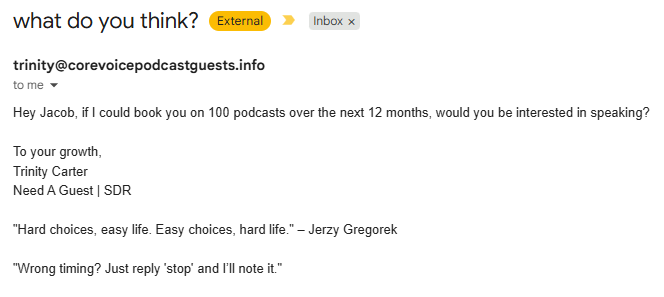
As far as I know these guys aren't Scammers, just Spammers. And yeah, this email is illegal.
That's not what I'm talking about here.
I'm referring to the growing practice of using automated marketing software to generate and send thousands of commercial solicitation emails that are intentionally crafted to look like personal, one-to-one correspondence. The goal is obvious: make the message appear as though it came from an individual taking the time to reach out personally, when in reality it's part of a large-scale marketing campaign.
If the primary purpose of that message is to advertise or promote a commercial product or service, changing the formatting to plain text doesn't eliminate the sender's legal obligations.
The law regulates commercial email—not HTML.
The Rules Didn't Change
The format of the email has evolved.
The law hasn't.
The CAN-SPAM Act established rules governing commercial email. Among other things, qualifying commercial messages are expected to provide recipients with a way to opt out of future emails, identify the sender, include a valid physical postal address, and avoid deceptive subject lines or other misleading practices.
Notice what the law does not say.
It doesn't require HTML.
It doesn't require hyperlinks.
It doesn't prohibit plain text.
A business can absolutely send a compliant plain text marketing email.
Unfortunately, many of these modern solicitation campaigns don't.
That's no accident.
Including a business name, physical mailing address, and clear opt-out instructions immediately reveals the message for what it is—a commercial marketing email. Those disclosures also make it easier for recipients and email providers alike to recognize the true nature of the message.
Many marketers appear willing to sacrifice compliance in exchange for slightly better inbox placement.
Junk Mail Isn't the Same as Scam Mail
There's another distinction worth making.
Not every unwanted marketing email is a scam.
Some companies are selling legitimate products or services. Others are attempting outright fraud.
Both often employ similar tactics.
Both may disguise themselves as personal correspondence.
Both may ignore the legal disclosure requirements that apply to commercial email.
The difference is that one intends to sell you something real, while the other intends to steal from you.
I don't object to legitimate businesses marketing legitimate products.
In fact, I do it myself.
Marketing isn't the problem.
Ignoring the rules while expecting everyone else to follow them is.
What I Do
My own policy has become very simple.
If I receive what is obviously a commercial solicitation that contains no business identification, no physical address, and no meaningful way to opt out of future messages, I report it as spam and block the sender.
Will that stop the campaign?
Certainly not.
The people behind these operations understand they'll burn through domains, IP addresses, and email accounts. That's simply another cost of doing business.
Still, reporting spam has value.
Every negative signal contributes to the sender's reputation. Every report makes it just a little more difficult for future campaigns to reach other inboxes.
It may only be a tiny dent.
It's still a dent.
I Used to Reply
When these plain text solicitations first started becoming common, I occasionally replied.
I'd explain that I had no interest in doing business with someone whose very first interaction with me involved ignoring the law and disguising advertising as personal correspondence.
I don't do that anymore.
I'm fairly certain no human is reading many of those replies anyway.
Today's marketing platforms are increasingly automated, and many of these campaigns are managed almost entirely by software.
I've decided my time is better spent clicking Report Spam.
The Same Principle Applies to Telemarketing
I handle deceptive phone calls much the same way.
When I accidentally answer a telemarketing call that's using a spoofed local number, I sometimes explain exactly why they won't be getting my business.
If your first interaction with me depends on deceiving me into believing you're local when you're not, you've already demonstrated something about your business that I can't ignore.
Maybe the tactic is legal.
Maybe it isn't.
Either way, it tells me everything I need to know.
The Best Defense
Reporting spam helps.
Protecting your information helps even more.
The fewer companies that possess your email address and phone number, the fewer opportunities there are for that information to find its way into lead databases that fuel these marketing campaigns.
Think carefully before handing over your contact information.
Read privacy policies.
Decline unnecessary marketing permissions.
Use alternate email addresses when appropriate.
If you're particularly serious about reducing unwanted solicitations, there are reputable privacy services that will work to remove your information from many of the data brokers that buy, sell, and aggregate consumer information.
No solution is perfect.
But reducing the availability of your personal information is one of the most effective ways to reduce the number of unwanted emails you'll receive in the first place.
A Word to Businesses
If your company is using one of these plain text outreach platforms, it's worth asking a few questions.
- Does every commercial email include the disclosures required by law?
- Can recipients easily opt out?
- Does the message clearly identify your business?
- Would you be comfortable if the recipient understood, from the very first sentence, that the email was generated as part of an automated marketing campaign?
If the answer to those questions is no, it may be time to reconsider the strategy.
A short-term increase in reply rates isn't worth sacrificing trust—or potentially compliance with the law.
The newest spam doesn't look like spam anymore.
That's exactly the point.
Don't mistake a change in appearance for a change in the rules.